Abstract
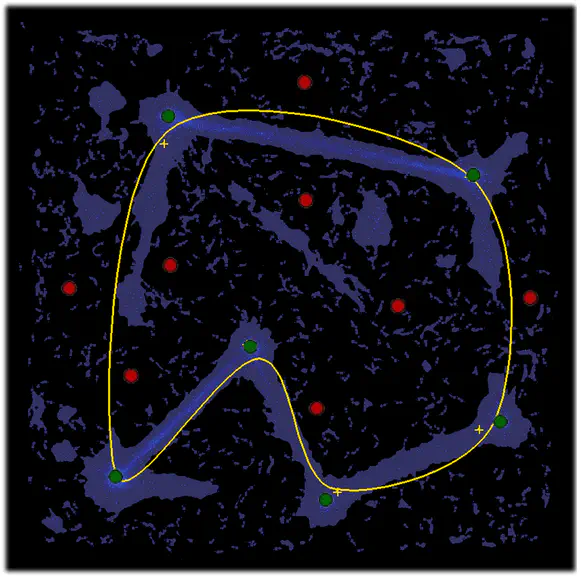
This paper presents a novel bio-inspired methodfor designing cyclic airspace corridors to support high-throughput, bidirectional flows of Unmanned Aircraft Systemsat Very Low Level. We adapt the Slime-Mold Algorithm togenerate corridors by modeling vertiports as attractors, no-fly zones as repulsors, and using a discretized pheromonefield to guide agent behavior. Agents operate in three roles:explorers, exploiters, and trail-thickeners, and interact solelyvia pheromone diffusion and decay. A food timer mechanismregulates exploration based on the average spacing betweenvertiports. From the resulting pheromone distribution, aCatmull–Rom spline is fitted to extract a smooth, continuouscorridor. The design is evaluated using five criteria; vertiportproximity, no-fly zone avoidance, self-intersection, curvaturesmoothness, and total length. We evaluate our approach onthree large-scale urban scenarios with up to 15 vertiportsand 10 no-fly zones. Results show convergence within 200iterations, rapid adaptation to topological changes, and thepotential to support more complex corridor structures givingpromises to the method’s suitability for real-time, dynamicairspace design in UAS traffic management.

Matthieu Verdoucq
Swarm Systems & UTM Researcher
After a PhD on creating a bio-inspired model for collective motion in a swarm of drones, I now study the use of UAV in tomorrow’s sky, and how to make it efficient and resilient at large scale.
Rodolphe FREMOND
AI/ML & UTM Researcher
Expert in Machine Learning for Conflict Resolution, UTM Services Integration, and Digital Twin Technology.
Zeynep BILGIN
PhD Candidate/Researcher
My research interests are guidance and navigation for multiple aerial vehicles.

Murat BRONZ
Assistant Prof. of Dynamic Systems and Head of Drones and UTM Research Chair
My research interests include all sorts of aerial robotics related subjects.