Abstract
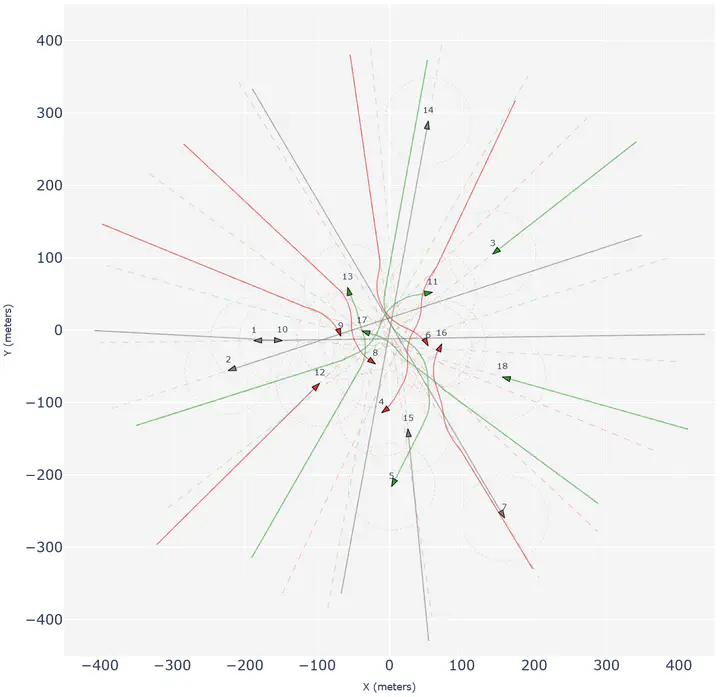
The aim of this study is to investigate how different tactical conflict resolution algorithms perform when operating concurrently within the same airspace at the Very Low Level (VLL). With the rise of Urban Air Mobility (UAM), new Unmanned Aircraft System (UAS) Traffic Management (UTM) must accommodate diverse UTM service providers monitoring several operations. Consequently, tactical conflict resolution may face safety issues due to interoperability limitations in an even more congested airspace. To assess the severity of these limitations, a simulation environment was developed, acting as a UTM service provider capable of supporting and synergizing multiple deconfliction algorithms. Two decentralized tactical deconfliction algorithms, Optimal Reciprocal Collision Avoidance (ORCA) and Potential Guidance Flow (PGFlow), were incorporated into the simulation and tested both individually and together. Through step-wise density scenarios, their performances have been assessed on both safety and cost-efficiency aspects. The results indicate that the simultaneous deployment of our two algorithms offers comparable performances to single method scenarios, demonstrating the feasibility of operating diverse deconfliction tools concurrently in urban airspace.
Zeynep BILGIN
PhD Candidate/Researcher
My research interests are guidance and navigation for multiple aerial vehicles.
Matthieu Verdoucq
Swarm Systems & UTM Researcher
After a PhD on creating a bio-inspired model for collective motion in a swarm of drones, I now study the use of UAV in tomorrow’s sky, and how to make it efficient and resilient at large scale.
Rodolphe FREMOND
AI/ML & UTM Researcher
Expert in Machine Learning for Conflict Resolution, UTM Services Integration, and Digital Twin Technology.
Murat BRONZ
Assistant Prof. of Dynamic Systems and Head of Drones and UTM Research Chair
My research interests include all sorts of aerial robotics related subjects.